



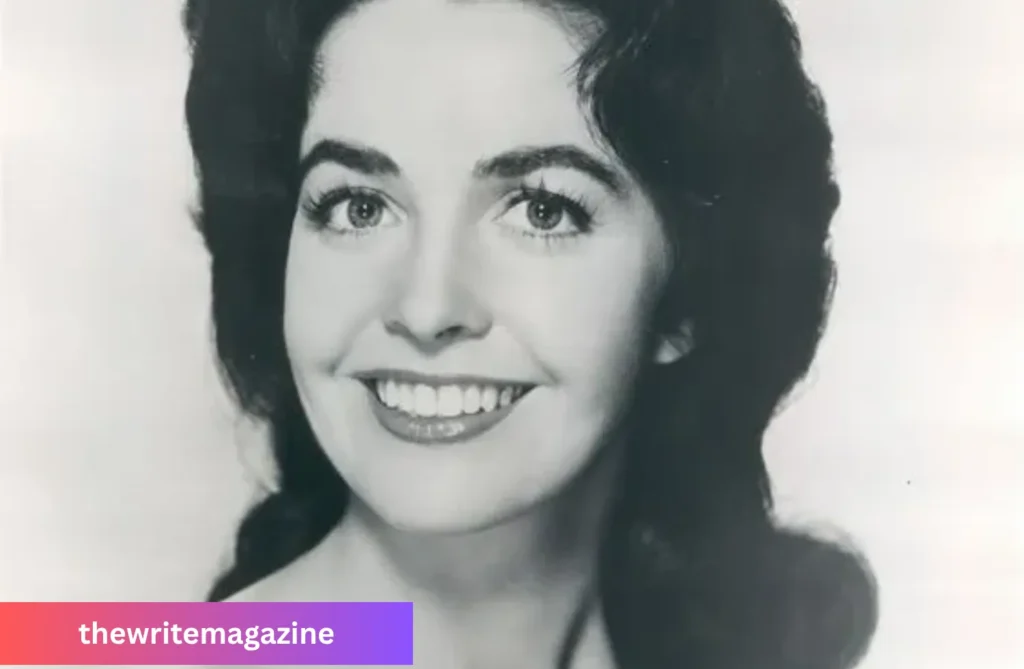
Myrna Fahey remains one of the most compelling and underappreciated actresses of Hollywood’s Golden Television Era. Born on March 12, 1933, in Carmel, Maine, she rose from small-town New England to the bright lights of Hollywood, carving out a career that spanned films, television, and stage. Best remembered for her roles as Maria Crespo in Walt Disney’s Zorro and as the haunted Madeline Usher in The Fall of the House of Usher (1960), Myrna Fahey brought intelligence, beauty, and nuance to every performance. Tragically, her life and career were cut short when she passed away on May 6, 1973, at just 40 years old, following a prolonged battle with cancer.
Early Life and Family Background of Myrna Fahey
Myrna Elisabeth Fahey was born the youngest of three children to Francis Edward Fahey, a boat builder, and his wife Olivia Newcomb, in the small town of Carmel, Maine, situated near Bangor. Her early childhood was rooted in the working-class rhythms of coastal New England. She attended Carmel Grammar School until the age of six, after which the family relocated to Southwest Harbor, near Bar Harbor, Maine, when her father secured employment at the Manset Boat Yard. Growing up near the ocean, the young Myrna was active in Girl Scouts, swimming, acrobatics, and dancing lessons — early pursuits that would later inform her physical grace and stage presence as a performer.
Growing Up in Southwest Harbor, Maine
Southwest Harbor became the backdrop for Myrna Fahey’s formative years. She was an energetic and sociable young woman who thrived in her community. A natural performer, she was a cheerleader at Pemetic High School, where she graduated at the age of 17. Her teenage years revealed a sharp competitive spirit: she began entering local beauty pageants in the early 1950s and, in 1952, became a runner-up in the Miss Maine beauty pageant. This early recognition of her poise and beauty set the stage — quite literally — for her future ambitions. She was, by all accounts, a popular and spirited young woman with dreams larger than the harbor town she called home.
Named After a Legend: The Myrna Loy Connection
One charming biographical footnote about Myrna Fahey is that she was named after the iconic Hollywood actress Myrna Loy, celebrated for her role as Nora Charles in The Thin Man series. This connection to old Hollywood was not merely symbolic — it reflected her parents’ affection for cinema and perhaps foreshadowed their youngest child’s own destiny on the screen. Fahey grew up with the namesake of a glamorous movie star, and she would eventually follow that path herself, earning comparisons not only to her namesake but also — and perhaps more frequently — to Elizabeth Taylor, whose striking looks Myrna was said to closely mirror, though Fahey possessed distinctive bright green eyes that set her apart.
Early Career: Beauty Pageants and the Road to Hollywood
Myrna Fahey’s journey to Hollywood was not immediate. After her near-win at Miss Maine, she pursued opportunities methodically. In 1955, she participated in the Miss Rheingold commercial beauty contest — a nationally visible competition that ran from August through October 1955, featuring six aspiring actress-finalists competing through a public vote. Although she did not win, Fahey received substantial national publicity through personal appearances and newspaper photo spreads. In January 1956, she was selected as a “Baby Star” in a short-lived revival of the old WAMPAS annual tradition. That same year, at her parents’ insistence, she moved to Hollywood, accompanied by two family friends, to pursue her acting ambitions full-time.
Training and Stage Work at the Pasadena Playhouse
Before breaking into television and film, Myrna Fahey invested seriously in her craft. She studied acting under the legendary Sanford Meisner at the Neighbourhood Playhouse, an institution renowned for its rigorous, technique-driven approach to performance. She also acted for one full season at the Pasadena Playhouse, one of America’s most prestigious regional theaters. At the end of 1957, she landed her first professional stage role, starring in the Pasadena Playhouse production of Holiday for Lovers. This theatrical grounding gave Fahey a disciplined foundation that distinguished her from many of her contemporaries who leapt directly into screen work without formal training.
Film Debut and Early Hollywood Roles
Myrna Fahey’s film debut came in 1955 with a small role in I Died a Thousand Times, a crime adaptation starring Jack Palance. It was a modest start, but it gave her vital on-set experience. She went on to appear in the biopic Jeanne Eagels (1957) alongside Kim Novak, and the Fred MacMurray western Face of a Fugitive (1959). Her range expanded with roles in Imitation of Life (1959) — the lavish Lana Turner melodrama — and The Story on Page One (1960), starring Rita Hayworth. These early films placed her alongside some of Hollywood’s biggest names, offering Fahey a front-row seat to the craft of professional filmmaking and strengthening her screen presence considerably.
Myrna Fahey in Walt Disney’s Zorro
One of Myrna Fahey’s most beloved roles came courtesy of the Walt Disney Company. Beginning with work at Disney Studios in the fall of 1957, she was cast as Maria Crespo in the iconic television series Zorro, which aired in 1958. The series was enormously popular with American audiences, and Fahey’s portrayal of Maria — a recurring romantic figure in the swashbuckling drama — made her a household name among fans of the show. Her Disney association brought her sustained exposure and cemented her status as one of the era’s most recognizable television actresses. It also set a template for her subsequent career: roles that emphasized her natural warmth, beauty, and the “moral overtones” that directors frequently noted in her screen persona.
Breakout Role: House of Usher (1960) with Vincent Price
Without question, Myrna Fahey’s most cinematically enduring role is that of Madeline Usher in Roger Corman’s House of Usher (1960), the atmospheric adaptation of Edgar Allan Poe’s chilling tale. Starring opposite the legendary Vincent Price as Roderick Usher, Fahey delivered a haunting and emotionally vulnerable performance that critics praised. The film became a landmark of American horror cinema, launching Corman’s celebrated Poe series and introducing mainstream audiences to Gothic horror in vivid color. Fahey held her own against Price — no small feat — and the film remains the role she is most frequently remembered for. Her portrayal of the doomed Madeline is considered one of the finest performances in the Corman horror canon.
Prolific Television Career Across 37 Series
Beyond her film work, Myrna Fahey was a remarkably prolific television actress. Over the course of her career, she appeared in episodes of 37 different television series from the 1950s through the early 1970s. Her credits read like a who’s who of classic American TV: Bonanza, Wagon Train, The Time Tunnel, Maverick, 77 Sunset Strip, Laramie, Gunsmoke, The Adventures of Superman, Kraft Suspense Theatre, Daniel Boone, Perry Mason, and Batman. She appeared four times on Perry Mason alone, playing different characters in each episode. In the late 1950s, she worked extensively in Westerns, often cast as the sheriff’s daughter — a pattern she found artistically limiting but pursued professionally.
Father of the Bride TV Series: Her Most Sustained Television Role
Myrna Fahey’s most consistent television opportunity came with the sitcom Father of the Bride, which aired for one season from 1961 to 1962. The series was based on the beloved film of the same name, originally starring Elizabeth Taylor. Fahey was almost certainly cast because, as one newspaper reviewer noted at the time, she looked “enough like Liz Taylor to be her sister.” Though the series ran for only one season, it showcased Fahey’s comedic timing and warmth, offering her a rare leading role on the small screen. The comparison to Taylor — a constant in Fahey’s professional life — was both a compliment and, in some ways, a double-edged sword that colored how audiences and directors perceived her independent talents.
The “Typecast” Problem: Breaking Free of “Good Girl” Roles
One of the most revealing aspects of Myrna Fahey’s career is the frustration she expressed publicly about typecasting. In a 1960 interview, she candidly complained that she was being confined to “good girl” roles because directors cited her “moral overtones” — an intangible quality of wholesome screen presence that she couldn’t easily shake despite her efforts to pursue more complex material. She explicitly stated: “I have moral overtones. There’s supposed to be an extreme ambivalence in everyone.” This tension between her public image and her artistic ambitions was a defining struggle. Over time, her Western roles did become more dynamic — after a particularly rough scene in Bonanza, her castmates famously presented her a mock award for “Best Slapper in a Filmed Series.”
Appearances in Iconic Shows: Batman, Perry Mason, and More
Myrna Fahey demonstrated her versatility by appearing across wildly different genres throughout her career. In 1966, she appeared in two episodes of the campy, beloved series Batman — “True or False-Face” and “Holy Rat Race” — playing a character named Blaze. Her four appearances on Perry Mason showcased her dramatic range across different character types, from defendant to murder victim. She also memorably appeared in a notable episode of Maverick alongside James Garner, featuring a young Clint Eastwood as a trigger-happy villain. These appearances across comedy, legal drama, Western, and superhero genres reflect a working actress determined to remain relevant and versatile in a highly competitive industry.
Personal Life: Joe DiMaggio, George Hamilton, and the FBI Threat
Myrna Fahey’s personal life attracted considerable public attention. She was known to have dated baseball legend Joe DiMaggio and actor George Hamilton, among others. Her relationship with DiMaggio in 1964 took a dramatic turn when she became the subject of death threats investigated by the FBI. Agents determined that the threats originated from a patient at the Agnews Developmental Center, a mental hospital in San Jose, California. The disturbed individual reportedly could not bear to see DiMaggio in a relationship with anyone other than Marilyn Monroe, who had died in 1962. The episode underscored the unexpected dangers that could accompany public life — and romantic associations with iconic figures — in mid-century America.
Off-Screen Interests: Skiing, Stocks, and Independent Spirit
Away from the cameras, Myrna Fahey was a woman of varied and spirited interests. She became an avid skier in California, embracing the physical thrill of the sport with characteristic enthusiasm. She was also notably financially astute: she invested actively in stocks, and one of her professional contracts stipulated that she have a stock ticker installed in her dressing room — a striking detail that reveals her as someone who took her financial independence seriously. She lived for a period in a large Beverly Hills apartment shared with her mother, and was registered as a Republican. These details paint the portrait of a woman who was intellectually engaged, financially self-reliant, and far more multidimensional than the “good girl” image Hollywood tried to confine her to.
Later Career: Peyton Place and Final Years
In the mid-to-late 1960s, Myrna Fahey continued working steadily in television. She appeared in the long-running primetime soap opera Peyton Place (ABC, 1964–1969) and also appeared in the medical drama Marcus Welby, M.D. As the 1970s began, her career entered its final chapter. She appeared in The Great American Beauty Contest (ABC, 1972–73), one of her final professional credits. By this time, however, Fahey was privately battling a serious illness. The years of sustained work across film and television demonstrated her professional commitment even as her health declined. She remained active in the industry until shortly before her death, a testament to her dedication to her craft and her resilience as a performer.
Death and Legacy of Myrna Fahey
Myrna Fahey passed away on May 6, 1973, at St. John’s Hospital in Santa Monica, California, following a prolonged battle with cancer. She was just 40 years old. Her death was mourned quietly — she had never achieved the front-tier stardom her talent may have warranted, but she had built a career of remarkable depth and breadth across the landscapes of American film and television. She is buried at Mount Pleasant Catholic Cemetery in Bangor, Maine, returned in death to the state that had shaped her. Myrna Fahey’s legacy endures primarily through House of Usher — still regularly screened by horror enthusiasts worldwide — and through the warm memories of audiences who grew up watching her grace the television screens of 1950s and 1960s America.
Why Myrna Fahey Deserves to Be Remembered
The story of Myrna Fahey is, in many ways, the story of countless talented women in mid-century Hollywood: immensely skilled, capable of far more than the industry allowed them to demonstrate, and ultimately defined by a handful of signature roles rather than the full richness of their work. Myrna brought genuine intelligence, physical presence, and emotional honesty to her performances, whether she was embodying the doomed Madeline Usher opposite Vincent Price or sparring with James Garner in a Western standoff. She pushed against the typecasting that constrained her, sought out better material, trained rigorously, invested wisely, and lived a life of independence and spirit. Film historians and classic television enthusiasts continue to rediscover her work — and with each rediscovery, the true scope of her achievement becomes clearer.
Conclusion
Myrna Fahey was more than a footnote in Hollywood history. From her roots in coastal Maine to the gothic halls of the House of Usher, from Disney’s sun-drenched California ranches to the campy Gotham of Batman, she navigated the full spectrum of mid-century American entertainment with grace, tenacity, and unmistakable talent. Her career encompassed over 37 television series, a memorable film run, and a stage presence trained under the best theatrical minds of her era. She was witty, financially savvy, romantically adventurous, and artistically ambitious in equal measure. Though she died far too young at 40, the work she left behind — particularly her unforgettable turn in Roger Corman’s House of Usher — ensures that Myrna Fahey will continue to be discovered, admired, and celebrated by new generations of classic cinema and television fans.
Frequently Asked Questions (FAQs) About Myrna Fahey
1. Who was Myrna Fahey? Myrna Fahey (March 12, 1933 – May 6, 1973) was an American actress best known for her roles as Maria Crespo in Walt Disney’s Zorro and as Madeline Usher in Roger Corman’s House of Usher (1960). She appeared in over 37 television series and numerous films during her career.
2. What is Myrna Fahey best known for? She is best remembered for her role as Madeline Usher opposite Vincent Price in The Fall of the House of Usher (1960), and as Maria Crespo in the Disney television series Zorro (1958). She also had recurring appearances on Perry Mason, Bonanza, and Maverick.
3. How did Myrna Fahey die? Myrna Fahey died on May 6, 1973, at St. John’s Hospital in Santa Monica, California, after a long battle with cancer. She was 40 years old at the time of her death.
4. Was Myrna Fahey named after Myrna Loy? Yes. According to IMDB trivia, Myrna Fahey was named after the iconic actress Myrna Loy, star of The Thin Man series. Throughout her career, she was more commonly compared to Elizabeth Taylor for her physical resemblance to the star.
5. Did Myrna Fahey date Joe DiMaggio? Yes. Myrna Fahey dated baseball legend Joe DiMaggio in 1964. The relationship attracted serious attention when she became the subject of FBI-investigated death threats from a mentally ill individual who was obsessed with DiMaggio’s late former wife, Marilyn Monroe.
6. Where was Myrna Fahey born and buried? She was born in Carmel, Maine, near Bangor, and is buried at Mount Pleasant Catholic Cemetery in Bangor, Maine, the state where she spent her childhood and formative years.
7. Where can I watch Myrna Fahey’s most famous film? House of Usher (1960), directed by Roger Corman and starring Vincent Price and Myrna Fahey, is widely available on classic film streaming platforms, DVD, and digital rental services. It remains a staple of the American horror film canon.