



The Nikola Badger is one of the most talked-about vehicles in electric truck history — not because it succeeded, but because of the dramatic rise and fall behind it. Announced in February 2020 by Nikola Corporation, the Badger promised to be the world’s first hydrogen and battery-electric pickup truck, boasting jaw-dropping specs that rivaled the Tesla Cybertruck and Rivian R1T. Yet within a year, the project collapsed amid fraud allegations against founder Trevor Milton. This article traces the complete story of the Nikola Badger — its origins, technology, controversies, cancellation, and surprising second life under a new company. If you’re curious about what happened to this once-hyped electric pickup, here’s everything you need to know.
What Is the Nikola Badger?
The Nikola Badger was a hydrogen fuel-cell and battery-electric pickup truck concept developed by Nikola Corporation, a company previously known for its zero-emission semi-trucks like the Nikola Tre. Unveiled to the public in early 2020, the Badger was designed to be sold in two configurations: a pure battery-electric vehicle (BEV) and a hybrid fuel-cell electric vehicle (FCEV) that combined hydrogen power with battery assistance. The goal was to create a heavy-duty work truck capable of outperforming traditional gas-powered pickups while producing zero emissions. It represented Nikola’s ambitious expansion beyond commercial trucking into the consumer and light-duty vehicle market.
The Origins of the Nikola Badger Project
The idea for the Badger stemmed from Nikola’s broader mission to dominate the hydrogen and electric vehicle space. According to CEO Trevor Milton, the company had already invested billions of dollars into hydrogen fuel-cell technology for its semi-truck program, and building a pickup truck was a natural extension of that infrastructure. Milton stated that the Badger would help “drive down the cost” of hydrogen components across Nikola’s entire vehicle lineup by sharing parts and suppliers. The project was formally announced on February 10, 2020, generating massive buzz across the automotive and clean-energy industries, especially given the timing alongside Tesla’s own electric pickup ambitions.
Key Specifications of the Nikola Badger
The Nikola Badger‘s technical specifications were designed to impress. The truck promised an estimated 906 peak horsepower, 455 continuous horsepower, and a massive 980 lb-ft of torque. It could reportedly accelerate from 0 to 60 mph in just 2.9 seconds — faster than the Ford F-150 Raptor. Range figures were equally striking: up to 600 miles when using the hybrid hydrogen-battery setup, or 300 miles on battery power alone. The truck measured 19.3 feet long, stood 6 feet high, and featured a 7-foot width with a 5.1-foot-wide cargo bed, positioning it as a genuine competitor in the emerging electric pickup segment.
Design and Build Features
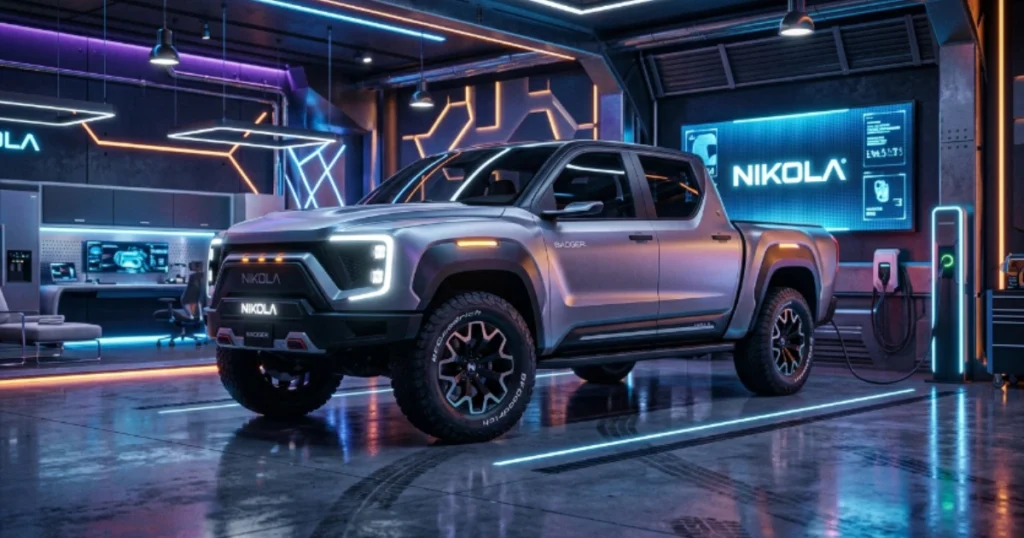
Beyond raw performance numbers, the Nikola Badger was engineered with real-world utility in mind. It featured a 4×4 independent wheel drivetrain, allowing it to handle steep grades of up to 40% without motor stall, even with a fully loaded trailer and combined vehicle weight of 18,000 lbs. A standout feature was its onboard 15-kilowatt power outlet, designed to run tools, lights, and compressors at job sites for roughly 12 hours without needing a generator. The exterior design showcased a rugged silver-and-black paint scheme, sleek LED headlights, and wheel-arch lighting, giving it an aggressive, work-ready aesthetic aimed squarely at construction and outdoor-lifestyle buyers.
Nikola Badger vs. Tesla Cybertruck and Rivian R1T
When it was unveiled, the Nikola Badger was positioned as a direct rival to the Tesla Cybertruck and Rivian R1T, two other high-profile electric pickups entering the market around the same time. Nikola claimed the Badger would be the “world’s most advanced zero-emission” truck, citing superior torque, horsepower, and dual-power flexibility as key differentiators. Unlike the Cybertruck’s pure battery-electric approach, the Badger’s hybrid hydrogen option theoretically gave it a longer range and faster refueling potential. However, none of these advantages were ever independently verified through real-world testing, since the Badger never reached production or public road trials.
The GM Partnership Announcement
In September 2020, Nikola Corporation announced a landmark partnership with General Motors (GM), under which GM would acquire an 11% equity stake in Nikola and provide engineering, manufacturing, and battery technology support — including production of the Badger. This deal was seen as a major validation of Nikola’s technology and business model, sending its stock price soaring. GM was expected to build the Badger using its own certified parts and manufacturing facilities, which would have given Nikola the credibility and infrastructure it lacked as a young company without prior vehicle production experience.
The Fraud Allegations That Changed Everything
Just weeks after the GM deal was announced, short-seller Hindenburg Research published a scathing report accusing Nikola founder Trevor Milton of making false claims about the company’s technology. The report alleged that a widely circulated video showing a Nikola semi-truck “driving” was actually filmed with the vehicle rolling downhill, not under its own power. These allegations triggered investigations by the SEC and Department of Justice, a plunge in Nikola’s stock price, and Milton’s resignation as executive chairman in September 2020. The scandal cast serious doubt on many of Nikola’s public claims, including those surrounding the Badger’s capabilities.
GM Scales Back Its Involvement
As the fallout from the fraud allegations intensified, General Motors reconsidered its partnership with Nikola. In November 2020, GM announced that its planned equity stake in the company would no longer proceed. A revised, scaled-down agreement was proposed instead, in which GM would still supply fuel-cell technology to Nikola’s semi-truck program — but critically, GM would no longer manufacture the Badger pickup truck. This was a devastating blow to the project, since Nikola had never built a production vehicle independently and had relied entirely on GM’s manufacturing expertise to bring the Badger to market.
Official Cancellation of the Nikola Badger
With GM’s manufacturing support withdrawn, Nikola Corporation officially cancelled the Badger program in late November 2020. The announcement caused Nikola’s stock to plunge further, as investors recognized that one of the company’s most publicly hyped products would never reach production. Reservation holders who had placed deposits for the Badger were reportedly offered refunds. The cancellation marked a turning point for Nikola, which shifted its focus back toward its core semi-truck business while facing mounting legal and financial pressure from the ongoing fraud investigation surrounding Milton’s public statements.
Trevor Milton’s Legal Downfall
The controversy surrounding the Nikola Badger and other company claims ultimately led to serious legal consequences for founder Trevor Milton. In 2022, Milton was convicted on charges of securities fraud and wire fraud for misleading investors about Nikola’s technology, including progress on the Badger program. In December 2023, he was sentenced to four years in prison. The case became one of the most prominent examples of fraud in the electric vehicle industry, serving as a cautionary tale about the gap between ambitious public announcements and verified engineering reality in the fast-moving EV startup space.
The Badger’s Surprising Second Life
Remarkably, the story of the Nikola Badger didn’t end with its cancellation. In February 2024, Nikola Corporation sold the intellectual property and remaining assets of the Badger program to a newly formed company called Embr Motors. The buyer was Dave “Heavy D” Sparks, a vehicle builder and television personality known from the show Diesel Brothers, working alongside business partner Cole Cannon. Embr Motors acquired the only two prototype Badgers ever built, along with Nikola’s abandoned off-road and personal watercraft vehicle assets, reigniting hope that the truck could eventually reach production under new ownership.
Nikola’s Financial Stake in Embr Motors
Interestingly, Nikola Corporation didn’t simply sell off the Badger assets outright — it structured the deal to retain some potential upside. Nikola provided financing to help Embr Motors purchase the assets in exchange for a 30% equity stake in the new company. According to Nikola’s chief legal officer, Britton Worthen, this arrangement was designed to “retain some value for its shareholders” if Embr succeeded in eventually bringing the Badger to market. The deal also involved Nikola clawing back a portion of shares that Milton had previously given to Sparks, reflecting the company’s efforts to distance itself from its founder’s legacy.
Why the Nikola Badger Still Matters Today
Even though it never reached showrooms, the Nikola Badger remains a significant case study in the electric vehicle industry. It illustrates both the enormous ambition and the real risks associated with EV startups making bold claims before proving out their technology. The Badger’s story — from a headline-grabbing reveal to a fraud scandal and eventual asset sale — offers valuable lessons about due diligence, corporate governance, and the importance of verifying manufacturing partnerships before making public promises. For automotive enthusiasts and investors alike, the Badger saga remains a widely referenced example of hype outpacing execution.
Lessons From the Nikola Badger Saga
The rise and fall of the Nikola Badger highlights several recurring themes in the electric vehicle industry. First, manufacturing partnerships are critical — Nikola’s reliance on GM proved fatal once that relationship soured. Second, transparency matters: exaggerated or false claims can trigger regulatory scrutiny and destroy shareholder value almost overnight. Third, even failed projects can find unexpected second chances, as shown by the Embr Motors acquisition. These lessons remain relevant for any company operating in the fast-evolving world of electric and hydrogen-powered vehicles, where technological promises must be matched by verifiable engineering results.
Could the Nikola Badger Ever Return to Production?
As of the most recent developments, Embr Motors has expressed a genuine desire to bring the Badger to market, reportedly engaging with several EV-related partners during acquisition talks. However, building and certifying a new vehicle from scratch is an enormously complex, capital-intensive process — one that even well-funded, experienced automakers often struggle to execute. Whether Embr can succeed where Nikola failed remains uncertain. For now, the Badger exists mainly as intellectual property and two prototype units, with its production future dependent on Embr securing sufficient funding, manufacturing partners, and regulatory approval.
Conclusion
The Nikola Badger stands as one of the most fascinating cautionary tales in modern automotive history. What began as a groundbreaking hydrogen-electric pickup truck promising to rival the Tesla Cybertruck and Rivian R1T ultimately collapsed under the weight of fraud allegations against Trevor Milton and the withdrawal of manufacturing support from General Motors. Yet the story didn’t end there — its assets found new life through Embr Motors in 2024, keeping alive the possibility that this ambitious truck could one day reach the market. Whether or not that happens, the Nikola Badger remains a defining example of both the promise and peril of the electric vehicle revolution.
Frequently Asked Questions (FAQs)
1. What is the Nikola Badger? The Nikola Badger is a hydrogen fuel-cell and battery-electric pickup truck concept unveiled by Nikola Corporation in February 2020, designed to compete with vehicles like the Tesla Cybertruck.
2. Is the Nikola Badger still being produced? No. Nikola Corporation officially cancelled the Badger program in November 2020 after General Motors withdrew its manufacturing support. In 2024, the assets were sold to a new company, Embr Motors.
3. Who founded Nikola Corporation? Nikola Corporation was founded by Trevor Milton, who served as CEO until resigning in September 2020 amid fraud allegations and was later convicted of securities fraud.
4. Why was the Nikola Badger cancelled? The Badger was cancelled after General Motors scaled back its partnership with Nikola following fraud allegations, which meant Nikola no longer had manufacturing support to build the truck.
5. What happened to the Nikola Badger prototypes? The two existing Badger prototypes, along with the project’s intellectual property, were sold to Embr Motors, a company founded by Dave “Heavy D” Sparks and Cole Cannon, in February 2024.
6. What was the Nikola Badger’s estimated range and horsepower? The Badger was estimated to deliver up to 906 peak horsepower, 980 lb-ft of torque, and a range of up to 600 miles using its hybrid hydrogen-battery configuration.
7. Could the Nikola Badger ever be released to the public? It’s possible but uncertain. Embr Motors has expressed interest in bringing the Badger to market, but significant funding, manufacturing partnerships, and regulatory approval would be required first.